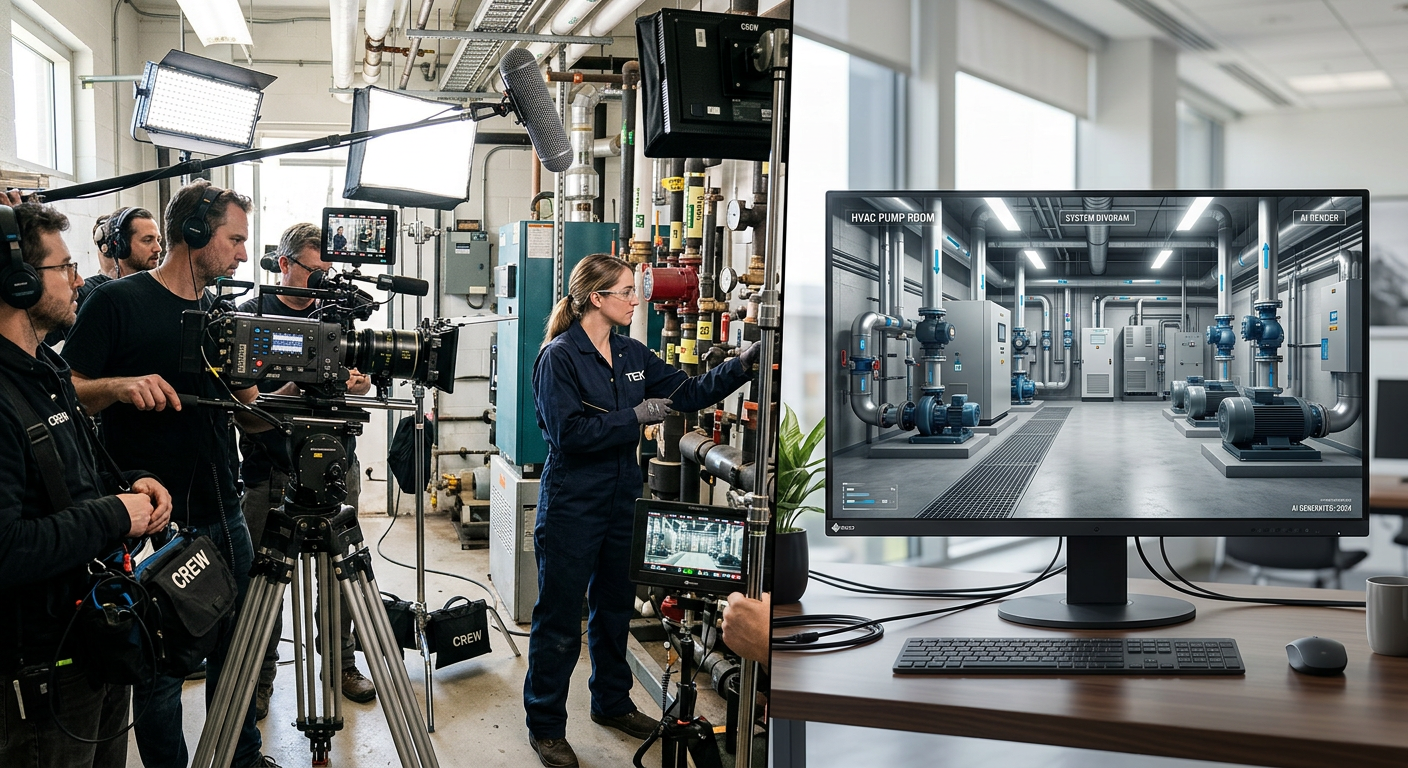
The main difference between AI video and a traditional video shoot is the requirement for physical reality. Traditional video production relies on cameras to capture actual people, locations, and physical products, while AI video generates imagery through software based on text or image prompts. Traditional shoots provide absolute accuracy for specific physical details, whereas AI video allows for rapid creation of conceptual scenes and high-end visuals without a film crew or physical set.
When should you choose a traditional video shoot?
You should choose a traditional video shoot when the specific visual details of your physical assets, employees, or locations must be 100% accurate. If you are an HVAC owner who wants to show your actual branded vans, your real technicians in their uniforms, and a specific installation in a customer's home, you need a camera. AI cannot currently replicate your specific physical inventory or staff members with the precision required to avoid looking "off" or "fake" to a local customer who knows your business.
Traditional production is about capturing truth. For a property management company, showing the actual lobby of a specific building or the real layout of a unit requires a traditional shoot. This process involves lighting, sound recording, and physical logistics. While more expensive and time-consuming, it builds trust because the viewer knows they are looking at the real thing. You can learn more about how we handle these projects on our video production service page.
When does AI video make more sense for a business?
AI video makes sense when you need to visualize concepts, create atmospheric b-roll, or produce high-end commercial visuals that would otherwise require a massive travel and equipment budget. If you need a shot of a storm hitting a residential roof to explain your emergency repair services, an AI tool can generate that scene in minutes. A traditional shoot would require waiting for a storm, hiring a drone pilot, and risking equipment, which is rarely cost-effective for a small service business.
AI is also ideal for social media content where the goal is to stop the scroll with an interesting visual rather than to prove a specific physical fact. It allows you to create "mood" pieces—like a peaceful living room with a perfectly functioning HVAC system visible in the corner—without renting a studio or hiring a lifestyle photographer. The primary advantage here is speed and the ability to iterate on ideas without recurring daily shoot costs.
Can you combine AI video and traditional footage?
Most successful video projects for service businesses today use a hybrid approach that mixes original footage with AI-generated elements. You use a traditional camera to film an interview with the business owner or a walkthrough of a finished job site to establish credibility. Then, you use AI to generate the "b-roll" or background footage that fills in the gaps, such as abstract shots of energy flowing through a home or conceptual visualizations of how a new furnace works.
This hybrid model keeps costs down while maintaining the "E-E-A-T" (Experience, Expertise, Authoritativeness, and Trustworthiness) that Google and customers look for. You get the benefit of a real human face—which builds trust—supplemented by high-production-value visuals that make your business look like a national brand. For a deeper look at these tools, see our guide on AI video for small business.
Comparison: Traditional vs. AI Video
| Feature | Traditional Video | AI-Generated Video |
|---|---|---|
| Visual Accuracy | 100% (Your actual products/team) | Approximate (Generic or conceptual) |
| Cost Factors | Day rates, crew, travel, gear | Software fees, prompting time |
| Turnaround | Days or weeks (Editing + Logistics) | Hours or days (Iteration) |
| Best Use Case | Testimonials, tours, "About Us" | Explainers, social ads, b-roll |
What are the honest limitations of AI video?
AI video currently struggles with "physical consistency," meaning characters or objects might change slightly between shots if not carefully managed. If you try to create a 30-second commercial using only AI, you might notice that a person's hair or the buttons on their shirt look different from one second to the next. This "uncanny valley" effect can be distracting and, in some cases, make a professional business look amateur or untrustworthy if overused.
Furthermore, AI cannot yet replace the specific emotion of a real customer testimonial. A customer describing how your HVAC team saved their pipes from freezing at 2:00 AM carries a weight that an AI-generated character cannot replicate. If the goal of your video is to build a human connection, AI is the wrong tool for the lead role.
How does this look for a local service business?
For a trades or property management operator, the choice usually comes down to the specific goal of the campaign. If you are launching a recruitment drive, you should use traditional video to show your real shop and your real team culture. If you are running a general brand awareness ad on Facebook about "preparing your home for winter," AI-generated clips of snowy houses and cozy interiors are much more efficient than sending a crew out to wait for snow.
From the field: We focus on systems where a human always stays in the loop for final approval. Our AI tools for businesses sit beside existing workflows, ensuring that while the technology handles the heavy lifting of generation or data routing, the business owner maintains control over the final brand image. For example, our Penkert Pulse system handles resident experience across 800+ units, but high-stakes communication still requires human review to ensure the "real world" context is accurate.
When you look at the demo films on our video production page, it is important to note those are AI-generated demonstrations designed to show the visual capabilities of the software, not specific client case studies. They illustrate what is possible when you remove the constraints of a physical camera and a traditional set.
By Jon Pfeiffer, Founder of Pfeiffer Digital
Jon Pfeiffer is the founder of Pfeiffer Digital in Oconomowoc, Wisconsin. Before that he led partnerships and customer success at StellarAlgo, a data platform for pro sports teams, and OwnBackup, and ran customer success and sales at Quicket Solutions.
Get your free AI auditFrequently Asked Questions
When is traditional video better than AI?
Traditional video is better for building trust through real-world evidence. Use it for customer testimonials, office tours, meet-the-team videos, and showcasing specific completed projects where the viewer needs to see your actual work and staff.
What are the best use cases for AI video in a small business?
AI video excels at creating 'b-roll'—the background footage used to fill gaps in a video. It is also ideal for visualizing abstract concepts, creating high-end social media ads on a budget, and producing content that would otherwise require expensive locations or weather conditions.
Can you mix AI video with filmed footage?
The most effective approach for service businesses is often a hybrid one. Use traditional video for the 'human' elements, like an owner interview, and use AI to generate the high-quality supporting visuals that make the production look like a national television commercial.