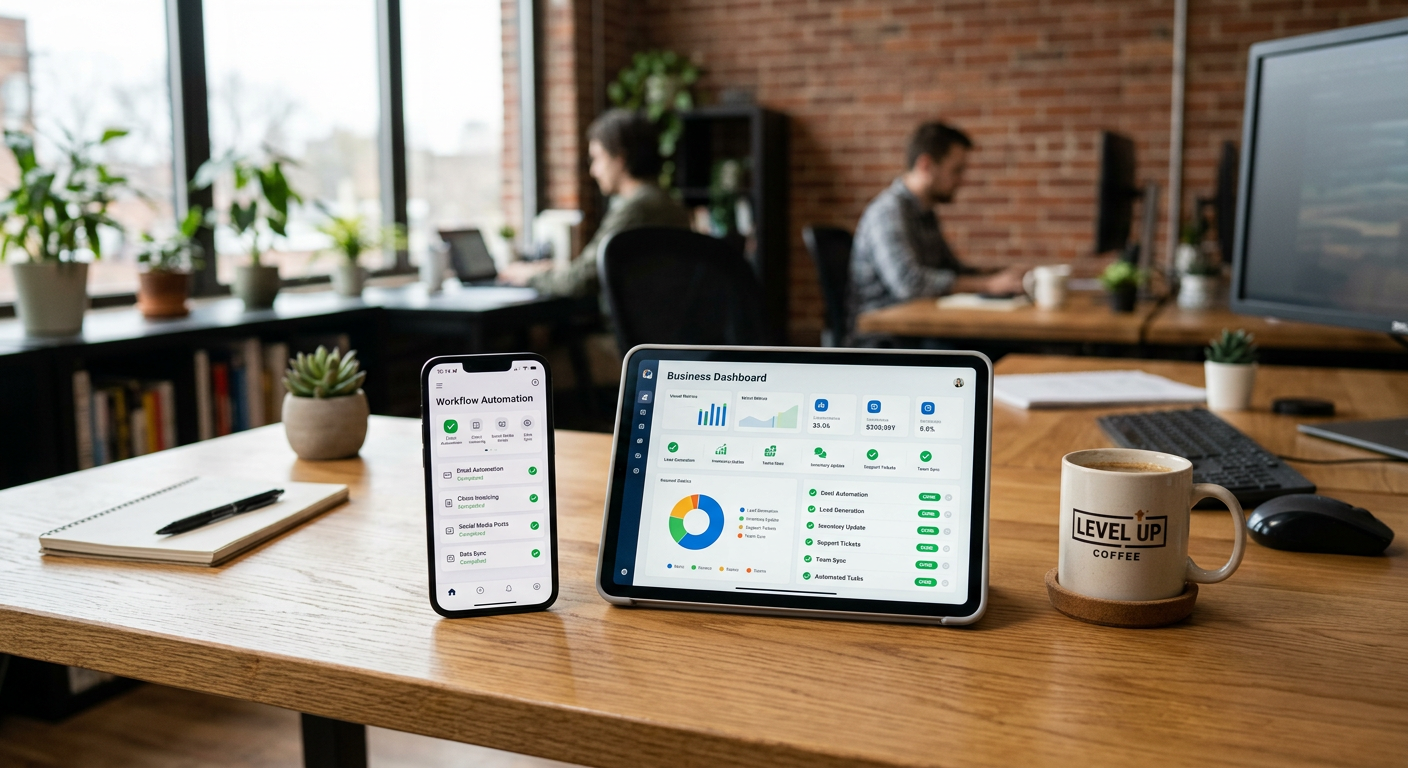
Small businesses can currently automate inbound lead capture, 24/7 phone reception, appointment scheduling, and back-office document matching. These systems function by integrating AI voice agents and large language models with your existing software to handle repetitive data entry and customer inquiries without human intervention. By focusing on these high-volume tasks, you can ensure leads are never missed and employees are freed from manual administrative work.
Can AI really answer my business phones?
Yes, AI receptionists can now handle 100% of inbound calls, providing immediate answers to common questions and routing urgent issues to your team. Unlike old-school automated menus that frustrate callers with "press one for sales," modern AI voice agents listen to the caller, understand their intent, and respond in a natural voice. They can book appointments directly into your calendar or qualify a lead based on your specific criteria before passing the information to a human.
For a service business like HVAC or plumbing, a missed call often means a missed job, especially when the average service ticket ranges from $400 to $1,200. An AI agent ensures that even if a pipe bursts at 2:00 AM, the customer speaks to a "representative" who can log the emergency and trigger an alert. This technology removes the bottleneck of a single front-desk person trying to manage phones, walk-ins, and paperwork simultaneously.
What back-office tasks are ready for automation?
Back-office automation currently focuses on document extraction and data matching, specifically for invoices, purchase orders, and property management records. AI models are excellent at "reading" a PDF or a photo of a receipt, finding the relevant numbers, and preparing that data for your accounting or ERP system. This eliminates the need for manual data entry, which is where most human errors occur.
A common application is how to automate purchase order matching. The AI identifies the line items on an incoming invoice and checks them against the original purchase order. If they match, the packet is prepped and flagged for a human to give the final "okay" before it enters the system of record. This keeps your data clean while significantly reducing the time spent on administrative "paper pushing."
How does lead capture and routing work with AI?
AI lead capture works by connecting your website forms, social media messages, and phone lines to a central brain that qualifies and routes inquiries in real-time. Instead of a lead sitting in an inbox for three hours, the AI reads the request, determines the urgency, and sends it to the specific person capable of handling it. This is particularly useful for companies managing multiple locations or specialized service lines.
- Instant Qualification: The AI asks the "must-have" questions (location, service type, budget) immediately.
- Smart Routing: Leads are sent via SMS or Slack to the specific technician or manager on duty.
- CRM Sync: All interaction data is automatically logged into your existing CRM without manual typing.
- Follow-ups: The system can send a text confirmation to the lead, so they stop calling your competitors.
Penkert Properties has 350+ leasing inquiries a month routed in under 60 seconds and saves 50–100 hours a month across 19 communities.
What are the honest limitations of AI for small business?
AI is not a "set it and forget it" replacement for your entire staff, and it is the wrong fit for complex, high-empathy situations or specialized technical troubleshooting. If a customer is calling to complain about a major service failure or a sensitive billing dispute, they need a human. AI is a tool for efficiency, not a tool for avoiding your customers.
Another trade-off is the "human-in-the-loop" requirement. We do not recommend fully autonomous systems that make financial payments or publish responses to negative reviews without oversight. For example, while AI can draft a response to a customer, it is vital that a human reviews any communication regarding 1-4 star reviews to ensure the tone is appropriate for the situation. AI handles the heavy lifting of drafting and organizing, but the owner or manager retains the final say.
Which industries benefit most from these automations?
Service-based businesses with high lead volume or complex scheduling needs see the fastest return on investment from automations. When your revenue is tied to how quickly you can respond to a request, AI acts as a force multiplier. This applies to trades like HVAC, electrical, and roofing, as well as professional services like property management and law firms.
| Business Area | What is Automated | The Human Role |
|---|---|---|
| Customer Service | 24/7 phone answering & FAQs | Handle escalations & complaints |
| Sales | Lead qualification & scheduling | Close the deal/perform the service |
| Finance | Invoice & PO data extraction | Final approval of payments |
| Operations | Maintenance request routing | Complete the physical repair |
How do I know if my business is ready for AI?
Your business is ready for AI if you have a repeatable process that is currently being slowed down by manual data entry or missed communications. If your team spends more than five hours a week moving data from one piece of software to another, or if you know you are losing leads because you can't answer the phone fast enough, the technology is ready for you. You don't need to change your entire workflow; these systems are designed to sit beside your existing tools.
A product distributor saves 50–75 hours a month on invoices and purchase orders prepared for human review. Results depend on the work being automated.
By Jon Pfeiffer, Founder of Pfeiffer Digital
Jon Pfeiffer is the founder of Pfeiffer Digital in Oconomowoc, Wisconsin. Before that he led partnerships and customer success at StellarAlgo, a data platform for pro sports teams, and OwnBackup, and ran customer success and sales at Quicket Solutions.
Frequently Asked Questions
How does an AI receptionist work for a small business?
An AI receptionist is a voice agent that answers your business phone lines 24/7. Unlike a traditional voicemail or a complex menu, it uses natural language to understand the caller, answer questions about your services, and book appointments directly into your calendar. It ensures no lead is ever missed, even after hours or during busy shifts.
Can AI handle my company's invoicing and paperwork?
AI can automate the extraction of data from invoices and purchase orders. It "reads" the documents, matches line items between them, and prepares the data for human review. This process significantly reduces manual data entry and errors, though a human should always provide the final approval before any data is officially entered into your accounting system.
Where is AI the wrong fit for my business?
AI is a poor fit for high-stakes emotional situations, complex technical troubleshooting that requires physical inspection, and any process involving financial payments without human oversight. It should be used to handle repetitive, high-volume tasks, while humans remain in charge of final decisions and sensitive customer interactions.