By Jonathan Pfeiffer, Founder of Pfeiffer Digital
Last updated: June 15, 2026
Quick Answer: RAG for small business stands for Retrieval-Augmented Generation. It is a technology that connects an AI model like ChatGPT to your company’s private documents, such as PDFs, emails, and training manuals. This ensures the AI provides accurate, brand-specific answers based only on your data rather than making things up or using general internet information.
What is RAG on your own data?
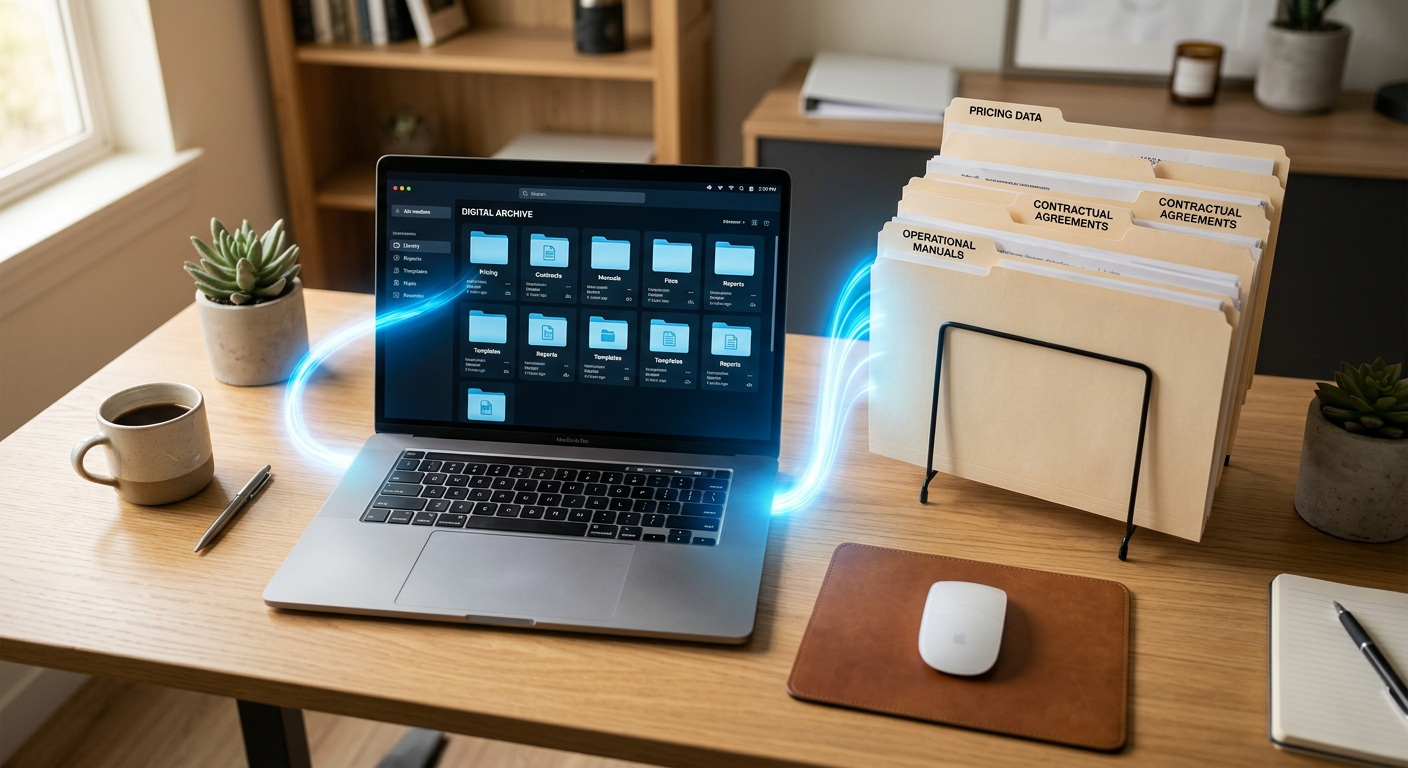
RAG on your own data is a method of giving an AI "open book" access to your specific business information. Think of a standard AI as a very smart student who has read the whole internet but doesn't know your company's price list or service area. RAG acts like a librarian that finds the exact page in your manual and hands it to the AI before it answers a question. This technology is the engine behind intelligent chatbots, automated customer support agents, and internal knowledge bases. While companies like OpenAI and Anthropic provide the underlying AI models, RAG is the framework that anchors those models to your private spreadsheets, PDFs, and database entries.
What problem does RAG on your own data solve for small businesses?
RAG solves the problem of "AI hallucinations" and the lack of specific company knowledge in standard AI tools. For a small business owner, this translates to solving three main pain points: messy knowledge management, slow employee onboarding, and inaccurate customer service. If a new hire has to ask you where the 2024 pricing sheet is three times a week, that is a drain on your time. If a customer asks an automated chat tool if you service Oconomowoc and the AI says "maybe" because it doesn't have your zip code list, you lose a lead. RAG ensures the AI knows exactly what you know, providing 24/7 accuracy without you having to take the call or search the folder yourself. It turns your "tribal knowledge" into a searchable, talking asset.
How much does RAG on your own data cost?
The cost of RAG depends on the volume of data you are processing and whether you use a DIY "wrapper" or a custom-built enterprise solution. Most small businesses can expect to pay for a software subscription or a one-time build fee plus ongoing monthly maintenance. Having built digital products for giants like Disney, Amazon, and the NBA, I've learned that the most expensive part of tech isn't the software—it's the time lost to a tool that doesn't work right. RAG is affordable because it scales with your usage.
| Feature | DIY / Basic SaaS | Professional Implementation |
|---|---|---|
| Setup Fee | $0 - $50 | $2,500 - $10,000 |
| Monthly Cost | $20 - $100/mo | $1,500 - $5,000/mo |
| Data Quality | Manual uploads only | Auto-syncs with CRM/Drive |
| Accuracy | Moderate (Basic) | High (Optimized) |
Want help deploying RAG on your own data this week? Get a free AI audit.
How to deploy RAG on your own data in your business this week
- Start with a "Chat with PDF" tool: For under $20, you can use tools like ChatPDF or Claude to upload a single manual and ask it questions. This is the fastest way to see the value, though it isn't automated.
- Use a "No-Code" Knowledge Base: Platforms like Chatbase or Mendable allow you to point an AI at your website URL or a folder in Google Drive. This creates a simple chatbot you can embed on your site in an afternoon.
- Clean your data: AI is only as good as the info you give it. Spend a few hours deleting old versions of price lists or outdated service agreements so the RAG system only "retrieves" the current truth.
- Have Pfeiffer Digital implement a custom build: We build professional-grade RAG systems that sync directly with your CRM, email, and internal servers. Typical builds take 1–3 weeks and start at $1,500/mo. Check out our AI products to see how we integrate these into your workflow.
Real example: how a Waukesha County HVAC owner used RAG on your own data
An HVAC contractor in Waukesha County was struggling with "after-hours" tech support. Junior technicians would call the owner at 8:00 PM because they couldn't find the specific wiring diagram or error code for an older boiler model. We implemented a RAG system that indexed 15 years of technical manuals and past job notes. Now, the technician just types the boiler model into a private Slack channel. The AI "retrieves" the exact page from the 2009 manual and explains the fix instantly. The owner stopped getting dinner-time calls, and the "no-cool" calls were resolved 20% faster because the info was at the tech's fingertips.
Common mistakes to avoid with RAG on your own data
- Uploading dirty data: If you have three different versions of your "Refund Policy" in your folders, the AI will get confused. Always curate your source documents first.
- Ignoring "Citations": A good RAG system should tell you exactly which document it used to get the answer. If your tool doesn't show its sources, don't trust it for high-stakes business decisions.
- Over-complicating the tech: You don't need a massive server. Most SMBs can run a highly effective RAG system using cloud-based "vector databases" that cost pennies per month.
Ready to turn your company's documents into a 24/7 assistant? Book a 20-min call with Jon to scope a RAG on your own data build for your business.
Frequently Asked Questions
Is my company data safe with RAG?
When set up correctly through professional APIs (like those from OpenAI or Anthropic), your data is not used to train the public AI models. At Pfeiffer Digital, we ensure your RAG system is a "closed loop." This means your private PDFs and client lists remain your property and are never shared with the public internet.
Do I need to be a coder to use RAG for my business?
You do not need to be a coder to use RAG. While the underlying technology is complex, the interface you use is just a simple chat box or a search bar. We handle the technical "piping"—connecting your files to the AI—so you can just type questions and get answers in plain English.
What files work best with a RAG system?
RAG works best with text-heavy files like PDFs, Word documents, Excel spreadsheets, and text transcripts of videos or meetings. It can also read your website and your CRM notes. It is less effective with handwritten notes or low-resolution images unless you use additional OCR (optical character recognition) technology first.
Can RAG help with my customer service?
Yes. RAG is the best way to build a customer service chatbot that actually works. Instead of giving generic answers, it can look up your specific shipping rates, return policies, and service areas to give customers accurate help 24/7 without a human ever needing to intervene.
What is the difference between RAG and "Fine-Tuning"?
Fine-tuning is like sending an AI to medical school to learn a new style of speaking. RAG is like giving that AI a library card. RAG is much cheaper and faster for small businesses because you can update your data instantly by just adding a new file, whereas fine-tuning requires expensive retraining every time something changes.
For more information on how we can help your business, visit our contact page.
Frequently Asked Questions
Is my company data safe with RAG?
When set up correctly through professional APIs, your data is not used to train the public AI models. At Pfeiffer Digital, we ensure your RAG system is a "closed loop." This means your private PDFs and client lists remain your property and are never shared with the public internet.
Do I need to be a coder to use RAG for my business?
You do not need to be a coder to use RAG. While the underlying technology is complex, the interface you use is just a simple chat box or a search bar. We handle the technical "piping" so you can just type questions and get answers in plain English.
What files work best with a RAG system?
RAG works best with text-heavy files like PDFs, Word documents, Excel spreadsheets, and text transcripts. It can also read your website and your CRM notes. It is less effective with low-resolution images unless additional processing is used.
Can RAG help with my customer service?
Yes. RAG is the best way to build a customer service chatbot that actually works. It looks up your specific policies and service areas to give customers accurate help 24/7 without human intervention.
What is the difference between RAG and "Fine-Tuning"?
Fine-tuning is like retraining an AI's brain, which is slow and expensive. RAG is like giving the AI an "open book" to your data, which is faster, cheaper, and easier to update as your business grows.